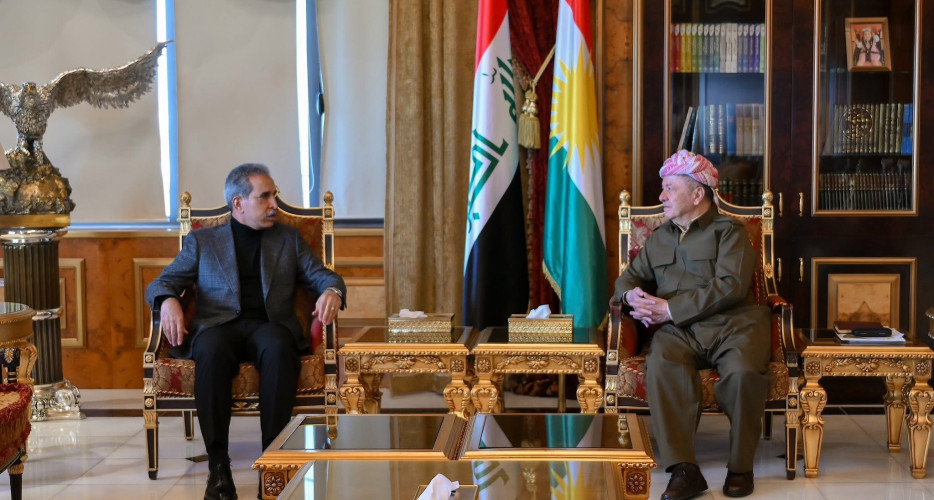
Peregraf - Amid the start of intensive discussions over selecting a candidate for the presidency of Iraq, Faiq Zaidan, President of the Supreme Judicial Council, arrived in Pirmam and held a meeting with Masoud Barzani, leader of the Kurdistan Democratic Party (KDP).
The visit comes at a sensitive political moment, as Iraq enters a critical phase in the constitutional process of electing a new president. Following recent changes within the Federal Supreme Court, Zaidan has increasingly emerged as a key constitutional authority, often described by political observers as a “guardian of the constitution.” In recent weeks, he has repeatedly warned political forces against violating constitutional timelines related to government formation.
Zaidan has also played a direct role in resolving parliamentary disputes. Most notably, he personally entered the Iraqi Council of Representatives to intervene in the controversy surrounding the election of the Second Deputy Speaker of Parliament—a post constitutionally allocated to the Kurds—highlighting his growing influence in managing institutional deadlocks.
No Details on Motive
Barzani’s headquarters did not disclose specific details regarding the main purpose of Zaidan’s visit. However, an official statement said that “the two sides exchanged views on the political situation in Iraq, the entitlements of various parties, and the steps of the Iraqi political process.”
The timing of the meeting has drawn attention, as it coincides with mounting pressure on Kurdish parties to reach an agreement on the presidency, a position traditionally held by a Kurd since 2005.
Race Against the Clock
According to the constitutional timeline, only 24 days remain to complete the process of electing the President of Iraq. Failure to meet the deadline could trigger further political and legal complications.
On the same day as the Zaidan–Barzani meeting, the KDP Politburo convened to discuss whether the party would officially nominate a candidate for the presidency, as it did in the previous two presidential terms. A member of the Iraqi parliament told Peregraf that the Politburo decided to engage in further talks with other political parties and has not yet settled on a final candidate.
Meanwhile, the Patriotic Union of Kurdistan (PUK), which considers the presidency part of its political entitlement, has also not officially submitted a nominee. The party is reportedly waiting to see the KDP’s position before making its move, reflecting the ongoing lack of consensus between the two main Kurdish parties.
Barzani’s Proposed Solutions
In previous statements, Masoud Barzani outlined several mechanisms to resolve the long-running dispute over the presidency. These include:
• The Kurdistan Parliament selecting a single candidate to represent the Kurds.
• Convening all Kurdish parties to agree on a consensus nominee.
• Allowing Kurdish representatives and blocs in the Iraqi parliament to choose the candidate.
• Selecting a candidate who does not necessarily belong to the KDP or PUK, but could come from another party or be an independent figure.
Despite these proposals, Kurdish forces have so far failed to reach a unified position, raising concerns that internal divisions could weaken their leverage in Baghdad.
As the constitutional deadline draws closer, political observers warn that continued delays may invite judicial intervention or external pressure, further complicating Iraq’s already fragile political process.