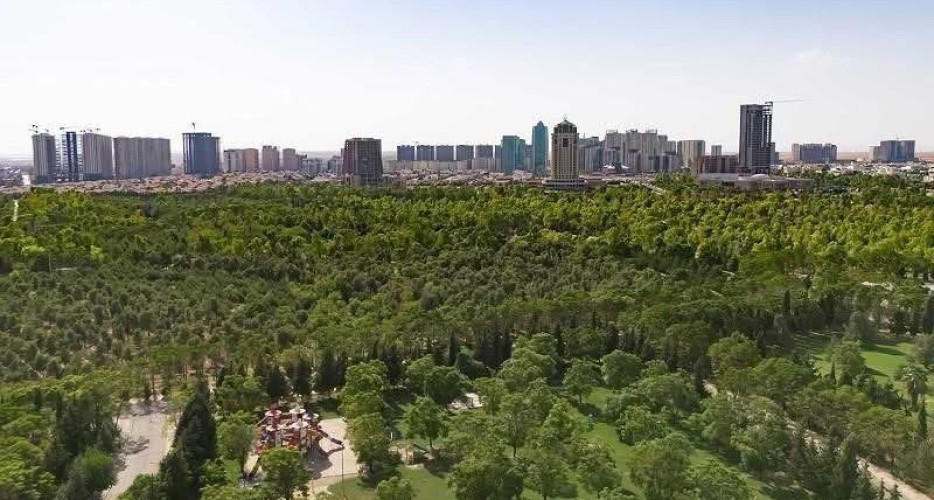
Peregraf — Green space across Erbil has increased significantly this year, with tree and flower planting rising by 20 percent compared to last year, according to Erbil Governor Omed Khoshnaw. Officials say the progress reflects a broader strategy by the Kurdistan Regional Government (KRG) to address environmental pressures caused by rapid urban growth, pollution, and climate change.
Khoshnaw announced that through the three nurseries operated by the Parks Department, a total of 128,341 trees and 106,527 flowers were planted in 2025 — the highest figure recorded in the past six years. The newly planted trees include climate-resilient species such as Sisem (Dalbergia sissoo), Albizia, Dodonaea, and Bauhinia (Camel’s Foot), selected for their ability to withstand Erbil’s hot and dry conditions.
Most of the planting took place in newly developed central medians or involved replacing dried and damaged trees across the city. In parallel with planting efforts, more than 73 locations — including parks, gardens, fountains, main streets, and central islands — were renovated this year.
According to the governor, the expansion of green spaces is being carried out under a long-term strategic plan. During the term of the Ninth Cabinet, officials say 1.5 million trees and flowers have been planted within Erbil Governorate. In addition, saplings were distributed to municipalities in Soran, Akre, Shaqlawa, and Bardarash, as well as to mosques, schools, and local residents.
Erbil Green Belt Launched
These efforts coincide with the launch of one of Erbil’s most ambitious environmental initiatives: the Erbil Green Belt. On October 30, 2025, Kurdistan Region Prime Minister Masrour Barzani planted the first tree of the project, officially marking its start.
Under the initiative, seven million olive and pistachio trees will be planted in a circular zone beyond Erbil’s 150-meter road, forming a belt two kilometers wide around the city. Speaking at the launch ceremony, Barzani described the project as having “historical significance” for both current and future generations.
“The return of olive trees to these areas, which are their historical source, has great meaning,” he said, emphasizing the cultural and symbolic value of olive cultivation in the region.
Barzani said the Green Belt would act as “a ring around the city of Erbil,” helping ensure a cleaner and healthier environment for residents. He reaffirmed his government’s commitment to long-term reconstruction and sustainable development, stating: “We, too, will gently and slowly continue to rebuild Kurdistan.”
The prime minister also thanked Greek experts and the private sector for their support, noting that the project reflects a wider strategy to strengthen the Kurdistan Region’s economic, tourism, and environmental infrastructure. While the land will remain under the Ministry of Municipalities, private companies involved in the project will be able to benefit commercially from future agricultural production.
“We don’t expect miracles to happen; we must create miracles ourselves,” Barzani said, adding that olive cultivation would generate both environmental and economic returns. The project is also expected to create new employment and training opportunities, particularly for young people.
“All of this will be a great effort to create job opportunities for our youth,” he said, stressing that diversifying the economy would reduce reliance on a single source of income.
Environmental and Economic Impact
The Green Belt project was formally announced on September 17 by Governor Khoshnaw. As part of the plan, ten water retention ponds will be constructed to support irrigation and cultivation.
Officials estimate the project could reduce carbon dioxide emissions by 140,000 to 210,000 tons per year, while also lowering temperatures, limiting desertification, and reducing dust storms. Beyond its environmental impact, the initiative is expected to boost agricultural production and create hundreds of jobs.
New Parks Under Development
Alongside the Green Belt, authorities are expanding urban green spaces within the city. Five new parks, covering nearly 200 acres, are currently under development:
- A park near the 120-meter road (80 acres, about 70% complete, 8,000 trees)
- Rashkin Park (47 acres, 16,000 trees planned)
- Nazdar neighborhood park (4 acres, 80% complete, 6,000 trees)
- Life neighborhood park (7 acres, 70% complete, 5,000 trees)
- A park near the 150-meter road intersection (60 acres, construction ongoing)
“These projects are designed to both protect the environment and enhance the beauty of Erbil,” Khoshnaw said.
Currently, Erbil is home to 26 major parks, 204 small gardens, 209 forests, 163 central islands, and 109 fountains. Environmental advocates have welcomed the recent initiatives but caution that long-term maintenance and strict enforcement of regulations will be essential to ensure their lasting success.