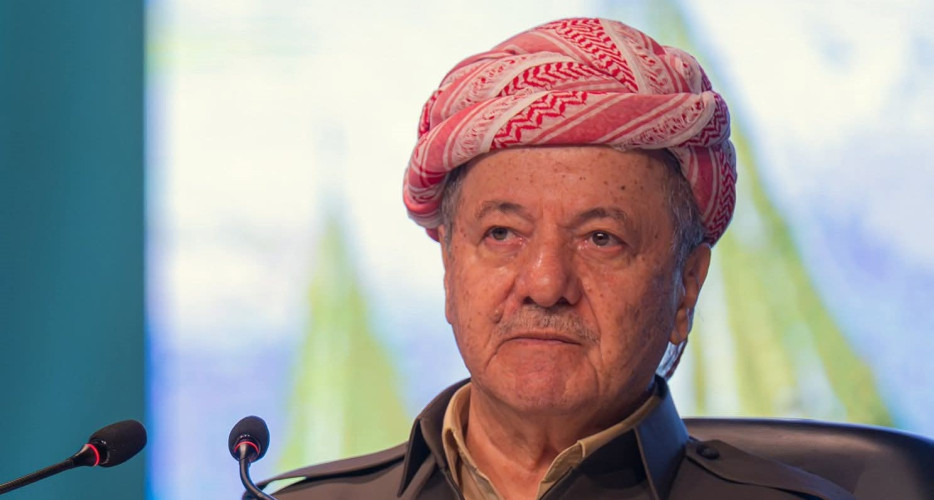
Peregraf — Kurdistan Democratic Party (KDP) President Masoud Barzani on Monday called for a unified Kurdish approach to the position of President of the Republic of Iraq, stressing that the post is a Kurdish entitlement and should not be treated as the exclusive property of any single party.
In a statement, Barzani said all Kurdish parties must be convinced that the presidency belongs to the Kurds and that the mechanism for selecting the president must be changed so the officeholder genuinely represents the people of Kurdistan. He emphasized that no party should regard the position as a private monopoly.
Barzani proposed several mechanisms to ensure Kurdish consensus: the Kurdistan Parliament could designate a candidate to represent the Kurds; all Kurdish parties could convene to agree on a nominee; or Kurdish members and blocs in the Iraqi Council of Representatives could select a candidate. He added that the president need not be from the KDP or the Patriotic Union of Kurdistan (PUK), noting that the nominee could come from another party or be an independent figure, provided they enjoy broad Kurdish support and represent the people of Kurdistan.
The statement comes as the Iraqi parliament is scheduled to hold its first session today, during which a Speaker of Parliament and two deputies are to be elected. The speakership is traditionally allocated to the Sunni component, with Sunni parties engaged in intensive consultations to reach a unified position ahead of the vote.
Under the constitution, parliament must elect the President of the Republic within 30 days of choosing the Speaker, requiring a two-thirds majority of 220 votes. The elected president then has 15 days to nominate a prime minister, who is granted up to 90 days to form a cabinet and seek parliamentary confidence.
Final election results show the Construction and Development Coalition, led by Prime Minister Mohammed Shia al-Sudani, emerged as the largest bloc with 46 seats, followed by the State of Law Coalition with 29 seats. Taqaddum and the KDP each secured 27 seats, while the PUK won 18 seats.
Meanwhile, the Shiite Coordination Framework announced it has formed the largest parliamentary bloc and reaffirmed its intention to nominate the next prime minister, stressing adherence to constitutional deadlines.
On the Kurdish front, the KDP and PUK have yet to reach a unified stance in Baghdad, particularly over the presidency, a post traditionally held by a Kurd. Iraqi political forces have repeatedly urged the two parties to reach an internal agreement, warning that continued division could complicate the next phase of government formation.