Peshmerga Minister Calls for Expanded U.S., Coalition Support in New Year Amid Reform Challenges
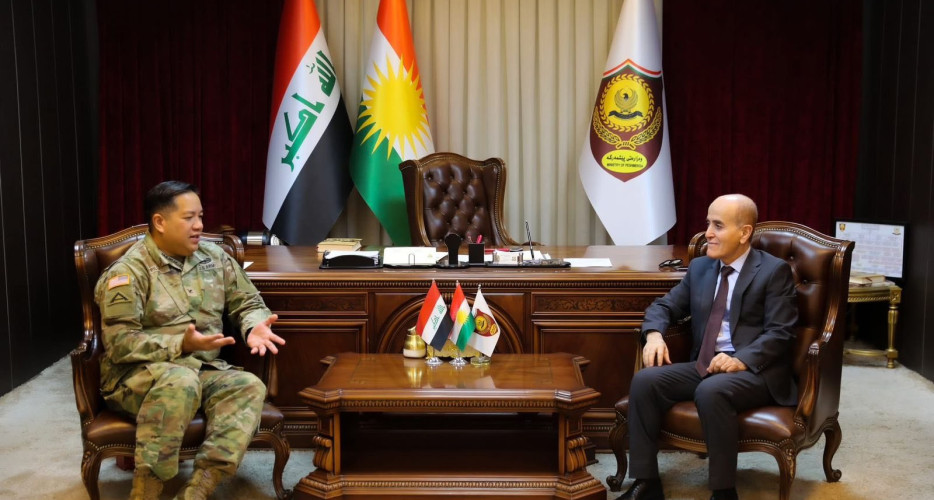
Peregraf — Kurdistan Regional Government (KRG) Minister of Peshmerga Shorish Ismail said he hopes U.S. and Coalition assistance to the Kurdistan Peshmerga forces will expand in the coming year, as the ministry continues coordination with international partners amid ongoing reform challenges.
According to a statement from the Ministry of Peshmerga Media Office, Minister Ismail received Colonel Deck Piluek, head of the United States Military Advisory Group at the U.S. Consulate General in the Kurdistan Region. The meeting focused on the joint work program for 2026 and included a review of the security situation in Iraq and the Kurdistan Region.
"We hope that in the new year, assistance from the United States and the Coalition for the Kurdistan Peshmerga forces will be expanded," Minister Ismail said, underscoring the importance of continued international backing.
Colonel Piluek welcomed the meeting with the minister and deputy minister, stressing the importance of preparations for the year ahead. He reaffirmed the joint work program and reiterated Washington’s commitment to providing ongoing support to the Ministry of Peshmerga.
However, efforts to reform and unify the Peshmerga forces continue to face significant obstacles. A July 2025 report by the U.S. Department of State’s Office of Inspector General warned that political rivalries, financial constraints, and stalled integration are undermining progress.
Central to the reform effort is a 2022 Memorandum of Understanding (MoU) between the United States and the KRG, which set out a four-year roadmap to integrate partisan forces—specifically the KDP-affiliated Unit 80 and the PUK-affiliated Unit 70—into a single, non-partisan structure under the Ministry of Peshmerga Affairs.
U.S. officials have noted limited progress. "Despite formal commitments, Peshmerga units remain fragmented along party lines, with little meaningful progress toward true unification," the report stated.
Analysts say the longstanding rivalry between the Kurdistan Democratic Party (KDP) and the Patriotic Union of Kurdistan (PUK) remains the core challenge, as both parties retain control over their affiliated forces, weakening the authority of the Ministry of Peshmerga Affairs and enabling corruption.
Since 2016, the United States and European partners have provided training, funding, and equipment to professionalize the Peshmerga. Coalition assistance, however, is conditional, with stipends and aid limited to non-partisan brigades formally transferred to the ministry.
At the same time, ongoing budget disputes between Erbil and Baghdad have delayed salary payments, further affecting troop morale. U.S. officials have cautioned that future support could be scaled back if Kurdish leaders fail to meet their MoU commitments.
Observers warn that without genuine political will from both the KDP and PUK, the reform agenda risks stalling. "It’s not enough to focus solely on the Peshmerga," the U.S. report stressed. "Broader reform of Kurdistan’s internal security forces and the end of party control are essential for long-term stability."