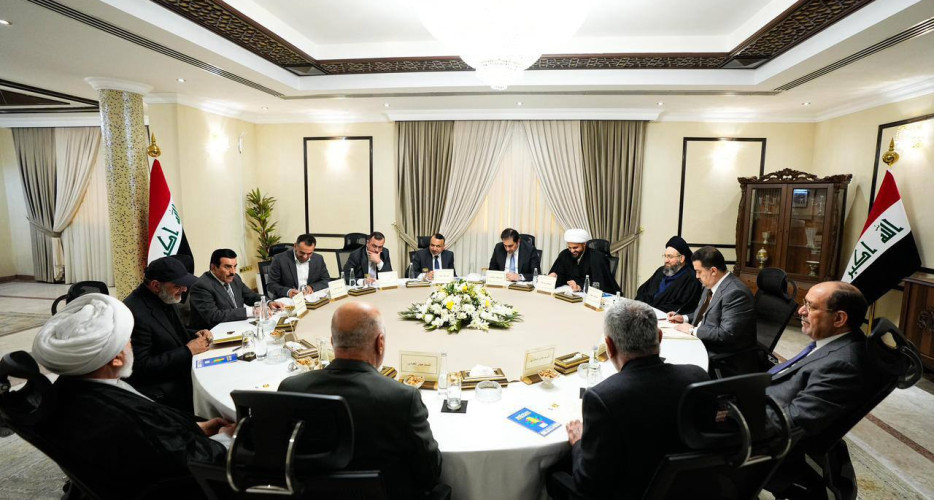
Peregraf — Iraq’s ruling Shiite Coordination Framework held a high-level meeting on government formation but did not finalize its nominee for prime minister, as political forces move into the constitutionally mandated phase following the ratification of the 2025 parliamentary election results.
In a statement issued after its regular meeting, held at the office of Prime Minister Mohammed Shia al-Sudani, the Coordination Framework said discussions focused on “national entitlements for the next phase” and the mechanisms for forming the new government in line with constitutional frameworks. The bloc called for the Council of Representatives to convene as soon as possible to elect the parliament’s presidency, while stressing the need for continued dialogue among all political parties to resolve outstanding issues related to government formation “with responsibility and understanding.”
The statement also underscored what it described as the Coordination Framework’s “pivotal national role” in safeguarding Iraq’s higher interests and managing political challenges with balance and wisdom, portraying the bloc as a key political authority representing the country’s largest social component and a guarantor of stability and constitutional order.
The meeting comes after the Federal Supreme Court on Sunday, December 14, 2025, ratified the final results of the parliamentary elections, formally triggering the constitutional timetable for forming the next government. Earlier the same day, the Supreme Judicial Council published the detailed timelines governing the process.
Under the constitution, parliament must elect the Speaker of the Council of Representatives and two deputies within 15 days of the ratification date. Following that, lawmakers have 30 days to elect the President of the Republic. Once elected, the president is constitutionally required to task a prime ministerial nominee with forming the government within 15 days. The designated prime minister will then have up to 90 days to present a cabinet and secure a confidence vote from parliament.
The President of the Republic must also call the first session of the new parliament within 15 days of ratification, by December 29. That inaugural session will be chaired by the oldest member of parliament, during which lawmakers will take the constitutional oath and elect the speaker and two deputies by an absolute majority. The post of speaker is traditionally allocated to the Sunni component, with Sunni blocs currently engaged in consultations to agree on a consensus candidate.
Within 30 days of the first parliamentary session, the legislature is required to elect a new president by a two-thirds majority—220 votes out of the 329-member Council of Representatives. The newly elected president will then formally task the largest parliamentary bloc, widely expected to be the Shiite Coordination Framework, with forming the next government.
According to the final election results, the Construction and Development Coalition led by Prime Minister Mohammed Shia al-Sudani secured first place with 46 seats, followed by the State of Law Coalition led by Nouri al-Maliki with 29 seats. Taqaddum and the Kurdistan Democratic Party (KDP) each won 27 seats, while the Patriotic Union of Kurdistan (PUK) obtained 18 seats. National voter turnout reached 56.11 percent.
Following the court’s ratification, the Coordination Framework announced it had formed the largest parliamentary bloc. In a meeting attended by senior leaders, including Prime Minister al-Sudani, participants reaffirmed their intention to proceed with nominating the next prime minister, pledging adherence to constitutional deadlines and national cooperation to ensure a smooth transition of power.