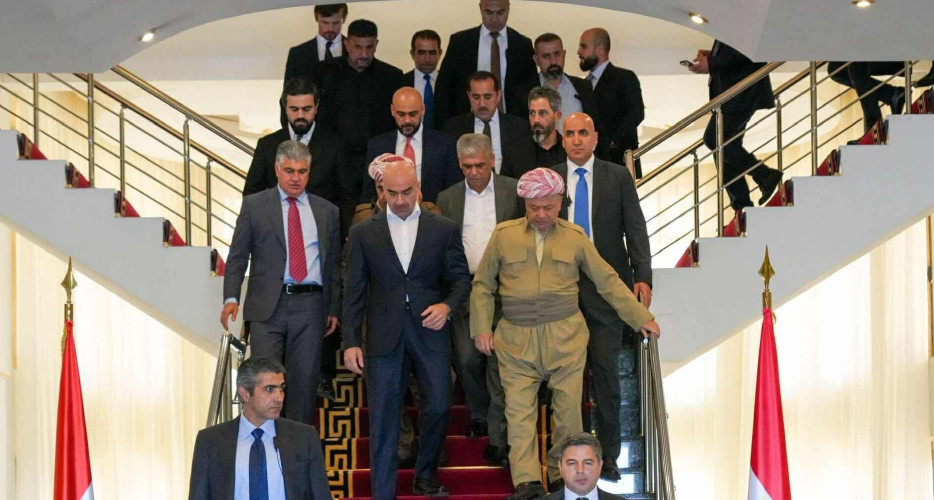
Peregraf - Iraqi Shia and Sunni political forces have called on Kurdish parties to reach a unified agreement on a single candidate for the presidency, urging the Kurdistan Democratic Party (KDP) and the Patriotic Union of Kurdistan (PUK) to resolve their differences in order to speed up government formation.
A high-ranking Kurdish source in Baghdad told Peregraf that Shia and Sunni factions have delivered a clear message to the Kurds, particularly the KDP and PUK, stressing the need to settle the presidency through a prior internal agreement. According to the source, Iraqi political forces are keen to see senior state positions resolved quickly and the new cabinet formed based on consensus among the election winners, without being drawn into internal Kurdish disputes.
By political convention established after the fall of the Ba’ath regime, the presidency of Iraq is allocated to the Kurds. Within the Kurdish political landscape, the post has traditionally been held by the PUK. However, the KDP challenged this arrangement in the previous term and is renewing its demand in the current political cycle. Kurdish sources indicate that without a broader agreement between the two parties—particularly on power-sharing in the Kurdistan Region and the formation of the Kurdistan Regional Government—it will be difficult to reach consensus on Baghdad positions, including the presidency. In such a scenario, the KDP and PUK may enter the presidential race with separate candidates, although negotiations to reach a comprehensive agreement are ongoing.
The developments come as the Iraqi Federal Supreme Court on Sunday ratified the final results of the Iraqi parliamentary elections, paving the way for the next constitutional steps. Iraq is now entering the phase of convening the first session of the new Parliament and electing the Speaker. The President of the Republic is constitutionally required to call the first parliamentary session within 15 days.
The position of Speaker of Parliament is traditionally allocated to the Sunnis. Winning Sunni factions have already met within the framework of a political council and are expected to agree on a candidate through internal consensus.
The first parliamentary session will be chaired by the oldest member, during which lawmakers will take the constitutional oath. In the same session, Parliament will elect the Speaker and two deputies by an absolute majority vote (50 percent plus one). Within 30 days of the first session, a new President must be elected by a two-thirds majority—220 votes out of 329 MPs. The elected President will then task the largest parliamentary bloc, widely expected to be the Shia Coordination Framework, with forming the new government within 15 days.
According to the certified election results, the KDP remains the leading political force in the Kurdistan Region, followed by the PUK. Significant shifts have also occurred among opposition parties: the New Generation Movement emerged as the biggest loser, while the Kurdistan Islamic Union (KIU) returned to the position of the third-largest party in the Region after a 15-year absence. The Halwest (Stance) Movement made notable gains, surpassing New Generation.
Out of the 46 seats allocated to the Kurdistan Region in the Iraqi Parliament—two of which are reserved for minority quotas—the remaining 44 seats were distributed as follows:
• Erbil (15 seats): KDP 9, PUK 3, Halwest 2, New Generation 1
• Sulaymaniyah (18 seats): PUK 8, Halwest 3, New Generation 2, KDP 2, KIU 2, Komal 1
• Duhok (11 seats): KDP 9, KIU 2
Overall seat distribution within the Kurdistan Region stands at: KDP 20, PUK 10, Halwest 5, KIU 4, New Generation 3, and Komal 1.
At the national level, Kurdish parties secured a total of 58 seats across Iraq’s provinces out of the 329-seat Council of Representatives. The breakdown is as follows: KDP 27, PUK 18, Halwest 5, KIU 4, New Generation 3, and Komal 1.