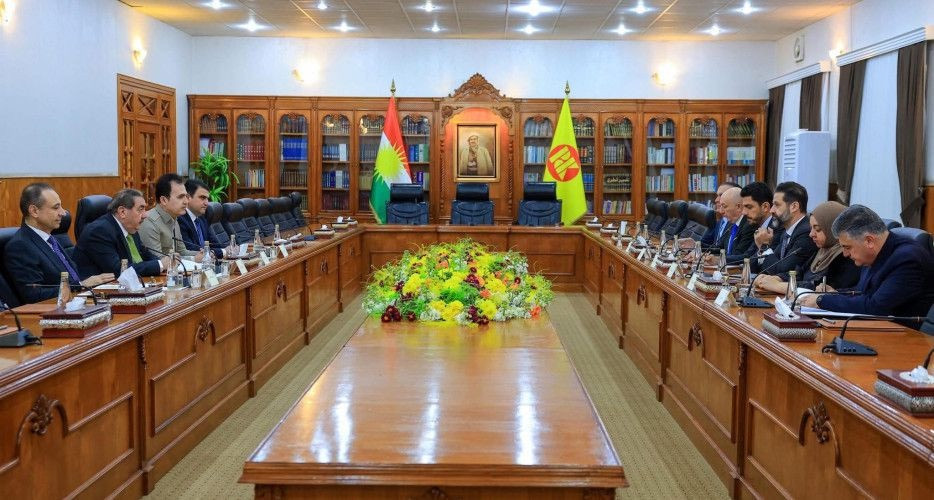
Peregraf- The Kurdistan Democratic Party (KDP) and the Patriotic Union of Kurdistan (PUK) are expected to meet in the middle of this week in a renewed attempt to form the long-delayed cabinet of the Kurdistan Regional Government (KRG), amid growing warnings that continued division is weakening the Kurdistan Region’s position in Baghdad.
Saadi Pira, a member of the PUK Political Bureau, stressed the urgency of unity between the two dominant Kurdish parties, saying that internal fragmentation is undermining Kurdish influence at the federal level.
“If we are not united in the Kurdistan Region, we will not be able to do anything in Baghdad and will be very weak,” Pira told reporters.
He linked KDP–PUK unity not only to government formation in Erbil, but also to coordination in disputed territories and the broader internal political arrangements of the Kurdistan Region.
Kurdish Divisions as Baghdad Moves Ahead
The renewed talks come as political forces in Baghdad move swiftly to shape the next federal government. The Shiite Coordination Framework has already declared itself the largest parliamentary bloc, claiming more than 170 seats, and is preparing to nominate Iraq’s next prime minister. Sunni parties followed days later, announcing the formation of the National Political Council, uniting more than 70 seats to negotiate collectively and secure shared demands.
By contrast, Kurdish parties remain divided, with no unified stance on whether they will enter federal negotiations as a single bloc or as fragmented groups. Observers warn that this division significantly weakens Kurdish bargaining power in Baghdad and risks undermining the Region’s political and constitutional rights.
In Iraq’s sixth parliamentary elections, six Kurdish parties won a combined 58 seats, in addition to five minority quota seats aligned with the KDP. Seat distribution among Kurdish parties stands as follows: KDP 27 seats plus five quota seats, PUK 18, Halwest 5, Kurdistan Islamic Union (KIU) 4, New Generation 3, and Komal 1.
Year-Long Stalemate in Erbil
More than a year after voters in the Kurdistan Region cast their ballots, the political standoff between the KDP and PUK has not only stalled the formation of a new KRG cabinet but is now threatening to marginalize Kurds in Baghdad’s ongoing negotiations to form the next Iraqi federal government.
Despite parliament convening for its first session in December 2024, it has been unable to reconvene since then, as electing a parliamentary presidium requires an agreement between the KDP and PUK. Disputes over the distribution of key posts have paralyzed the process, leaving the Kurdistan Region without a fully empowered government.
Election Results and Political Landscape
In the October 20, 2024 Kurdistan parliamentary elections, the KDP emerged as the largest party with 39 seats, followed by the PUK with 23. New Generation secured 15 seats, the KIU won 7, while the remaining seats were divided among smaller parties and minority representatives. Of the five minority quota seats, three are aligned with the KDP and two with the PUK.
Seven opposition parties—excluding New Generation—have rejected the election results, alleging fraud. The Kurdistan Justice Group (Komal) has announced a boycott of the entire parliamentary term, while the Iraqi Independent High Electoral Commission (IHEC) has rejected all accusations of electoral fraud.
This widespread rejection has complicated government formation, as several parties face political pressure and public skepticism that discourage them from joining the cabinet.
Coalition Still the Most Likely Outcome
Despite rising tensions, a coalition government between the KDP and PUK remains the most realistic path toward forming the tenth KRG cabinet. Together, the two parties control 67 seats when minority allies are included, with the KDP holding 42 seats and the PUK 25.
In practice, neither party can govern alone. Most other parties have either rejected the election results or declared themselves in opposition, leaving New Generation as the only actor capable of significantly altering the balance if it chooses to side decisively with one camp.
For now, the future of the tenth KRG cabinet remains uncertain, hinging on whether the KDP and PUK can overcome their differences—and whether New Generation will use its pivotal position to end the political stalemate or attempt to reshape the next government on its own terms.