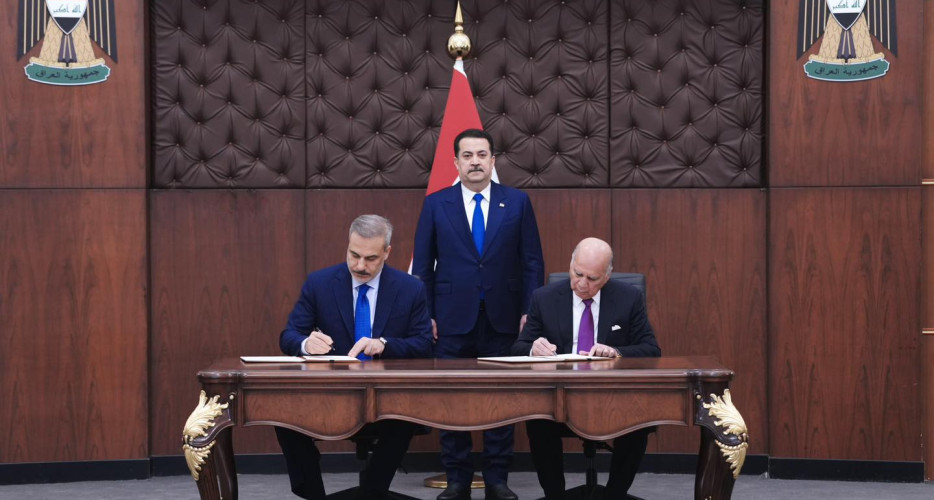
Peregraf- Iraq and Turkey signed their first formal water agreement in Baghdad on Sunday, a move officials hailed as "historic" and a major step toward tackling one of the Middle East’s most severe water crises.
The accord, signed under the supervision of Iraqi Prime Minister Mohammed Shia’ al-Sudani by the foreign ministers of both countries, aims to establish a long-term framework for managing shared water resources, launching large-scale joint projects, and expanding cooperation to confront dwindling water supplies.
Al-Sudani said the pact would facilitate "a package of major joint water projects" to address Iraq’s water scarcity, which has intensified over the past decade and accelerated desertification across much of Iraq, including the Kurdistan Region.
Turkish Foreign Minister Hakan Fidan, who arrived in Baghdad earlier on Sunday and held talks with Iraqi Foreign Minister Fuad Hussein, called the agreement "very important" after years of negotiations. He said discussions on such a framework began two and a half years ago based on a two-stage roadmap: improving shared water use, and enhancing water management systems within Iraq.
Hussein stressed that the agreement marks a milestone in relations, describing it as "the first document signed in the history of relations between the two countries to regulate water relations." He said it followed extensive meetings in Ankara aimed at securing mutual understanding on shared water resources.
Six Major Water Projects Planned
Iraq’s Ministry of Water Resources said the agreement includes six major projects focused on water harvesting and land reclamation. According to ministry spokesperson Khalid Shamal, three projects involve building small dams, each able to store five to ten million cubic meters of water. The dams are designed to collect runoff, protect rural communities from flash floods, and support farming and grazing areas. The remaining projects will focus on reclaiming agricultural lands.
"These dams will secure water, protect villages from flooding, and enhance agricultural productivity," Shamal said, adding that the water file has now become a "sovereign priority" for Baghdad.
Shamal noted that Baghdad has formally requested Ankara increase daily water releases from both the Tigris and Euphrates to 500 cubic meters per second each, with the expectation that inflows may rise to one billion cubic meters.
On October 10, Hussein and Fidan announced that both countries had reached an urgent understanding on water management. Hussein said the deal represents Baghdad’s commitment to long-term water security, while Fidan emphasized that Turkey is also facing water pressures and needs a joint strategy to manage shrinking resources.
Iraq Faces Worst Water Year in Nearly a Century
Iraq is enduring one of its most severe water shortages in decades, threatening agriculture, energy, and livelihoods. The country relies heavily on the Tigris and Euphrates rivers, which flow in from Turkey and Syria before reaching Iraq. Climate change, weak regulation, upstream dam construction, and poor water management have compounded the crisis.
A Peregraf investigation earlier this year revealed alarming water mismanagement in the Kurdistan Region—traditionally one of Iraq’s main water reservoirs. The report found more than 1,650 springs had dried up, groundwater levels in Erbil had fallen by up to 500 meters since the 1990s, and water levels at Dukan and Darbandikhan dams had dropped to record lows.
Water specialists warn that without comprehensive reform, Iraq risks irreversible agricultural decline and widespread desertification.
"If no action is taken, both surface and groundwater are at risk," said Dr. Abdullah Botani, a water resources expert.
Analyst Sarmad Latif added, "Iraq now ranks among the lowest globally in water security. The future is bleak unless strategic planning begins immediately."
A Regional Imperative
With Iraq’s water future tied to rivers originating outside its borders, cooperation with regional neighbors-particularly Turkey-has become crucial. Sunday’s agreement is seen as an initial step toward institutionalizing water coordination, though the success of the pact will depend on implementation and continued political engagement.
Officials from both countries say further technical talks are planned to define timelines, project scope, and joint mechanisms.
For Iraqis facing collapsing crop yields, shrinking rivers, and encroaching desert, the stakes could not be higher. The new agreement, while long overdue, may offer a rare pathway toward stabilizing one of the most critical resources in the region.